In the quiet corners of Sun Valley, California, the air smells less like the typical grease of a restoration shop and more like the clinical precision of an aerospace hangar. This is the sanctum of Singer Vehicle Design, a firm that has spent the last decade and a half fundamentally shifting our collective understanding of what a “classic” car can be.

To call what Singer does a “restoration” is an understatement of the highest order. Under the visionary guidance of founder Rob Dickinson, Singer has moved beyond the mechanical and into the metaphysical. They have taken the Porsche 911, specifically the 964 chassis, and distilled it into its most essential, potent, and beautiful form. Their mantra, “Everything is Important,” isn’t just a marketing slogan; it is an engineering mandate that dictates every stitch of leather and every titanium bolt.
The Genesis of the “Analogue Jewel”
The story of Singer begins not in a boardroom, but on the stage. Rob Dickinson, former frontman for the English rock band The Catherine Wheel, founded the company in 2009 with a singular obsession: to create the ultimate air-cooled 911.
Dickinson understood the visceral, tactile connection between man and machine. While modern supercars were becoming increasingly insulated and computerized, Dickinson sought to build an “analogue jewel.” The result is a vehicle that captures the aesthetic spirit of the early “long-hood” 911s of the 1960s and 70s, while harboring the chassis rigidity and performance of a 21st-century machine.
The Foundation: The 964 Chassis
For the uninitiated, the choice of the Porsche 964 (1989–1994) as a donor car is a masterstroke of engineering logic. It represents the “Goldilocks” era of the 911 lineage. It was the final evolution of the classic silhouette before the more muscular 993 arrived, and it retained the iconic air-cooled flat-six engine while introducing modern coil-spring suspension and better aerodynamics.
Singer strips these donor cars down to the bare metal, performs a surgical “seam-welding” process to increase structural rigidity, and then begins the transformation. By replacing the majority of the body panels with bespoke carbon fiber, Singer significantly reduces the curb weight compared to the original donor car. While a standard Singer commission achieves a lean profile through carbon fiber, the company’s focus on the Dynamics and Lightweighting Study (DLS) pushed the envelope to an extreme, targeting a curb weight of approximately 990 kg (2,180 lbs) through the use of magnesium, titanium, and advanced composites.
The Powerhouse: A Legacy of Collaboration
Perhaps the most impressive aspect of Singer’s evolution is their ability to attract the world’s greatest engineering minds. For their Dynamics and Lightweighting Study (DLS), Singer collaborated with Williams Advanced Engineering.
A cornerstone of this project was the development of the 4.0-liter, naturally aspirated, four-valve-per-cylinder flat-six engine. In the early development stages, Singer had the distinct honor of consulting with the late Hans Mezger, the legendary designer of the original Porsche flat-six. The DLS engine stands as a tribute to that lineage, screaming to a 9,000 RPM redline and producing 500 horsepower without the aid of turbochargers. This engine is not just a piece of machinery; it is an architectural triumph, featuring magnesium and carbon fiber components that look like they belong in a modern art museum.
Design as a Narrative
A Singer commission is often named after its eventual home, the Fuji Commission, the Mountain View Commission, or the DLS Turbo. Each car is a unique narrative written in leather and nickel.

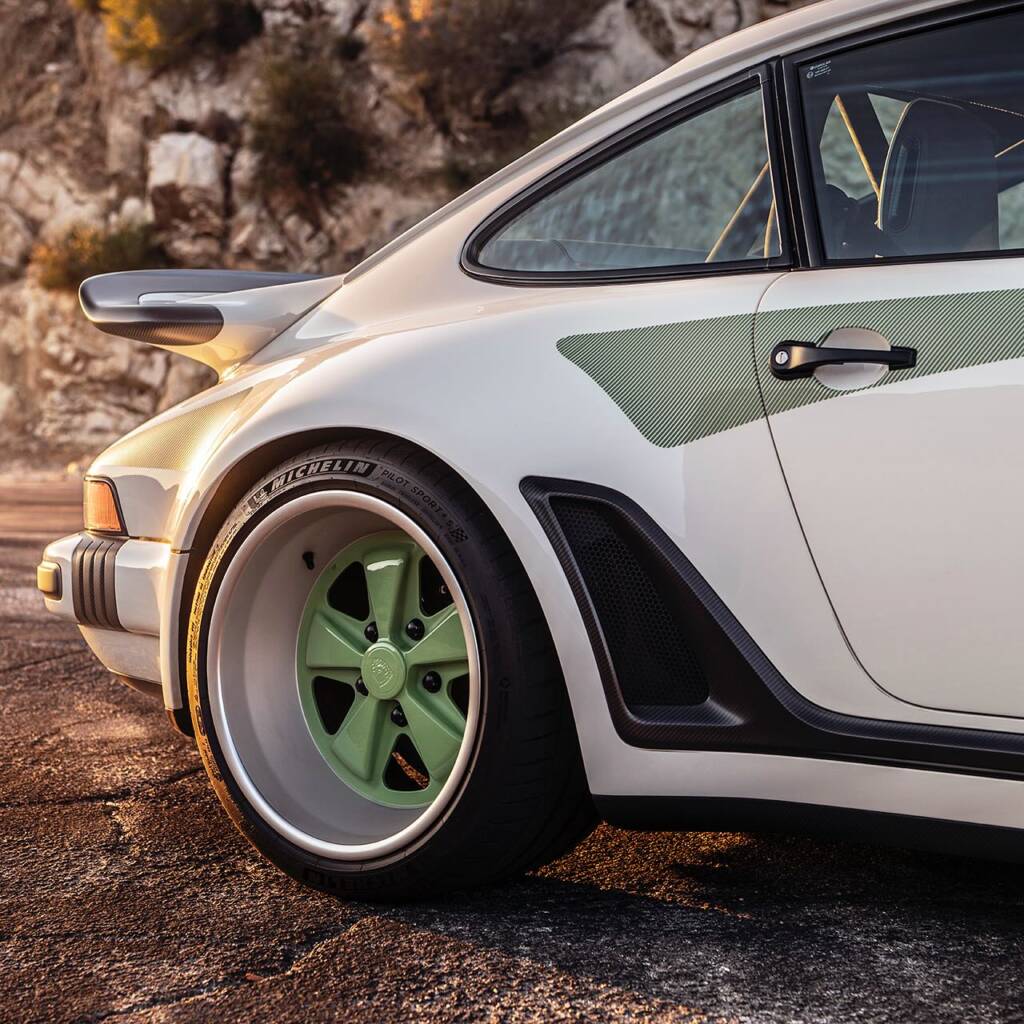


Step inside a Singer, and you are greeted by an interior that redefines “bespoke.” The “woven leather” seats are a signature of the brand, a tactile masterpiece that requires hundreds of hours of manual labor. The gauges are presented like luxury horology, with the tachometer often finished in gold leaf or a contrasting hue to emphasize its importance.
The nickel-plated hardware, from the door handles to the fuel filler cap, offers a warm, vintage luster that chrome simply cannot replicate. It is this commitment to the “tactile touchpoints” that ensures the driver feels the quality of the build before they even turn the key.
The Cultural Impact: Setting the “Restomod” Standard
Before Singer, the term “restomod” often carried a connotation of mismatched modern tech. Singer elevated the entire industry. They proved that you could respect the heritage of a brand while simultaneously improving every single metric of its performance.
They have influenced an entire generation of designers and restorers, creating a “Singer Effect” where the market value of air-cooled Porsches has skyrocketed. They have successfully bridged the gap between the automotive world and high luxury, standing shoulder-to-shoulder with brands like Patek Philippe or Hermès.
The Future of Air-Cooled Perfection
As the automotive world pivots toward electrification, Singer stands as a guardian of the internal combustion flame. They are not Luddites; they simply believe that the sensation of a mechanical gear shift and the unique “bark” of an air-cooled flat-six are experiences worth preserving.
Through their relentless pursuit of perfection, Singer Vehicle Design has ensured that the Porsche 911 will not just be remembered as a classic car of the 20th century, but as an evolving masterpiece that continues to be reimagined for the connoisseurs of the 21st.